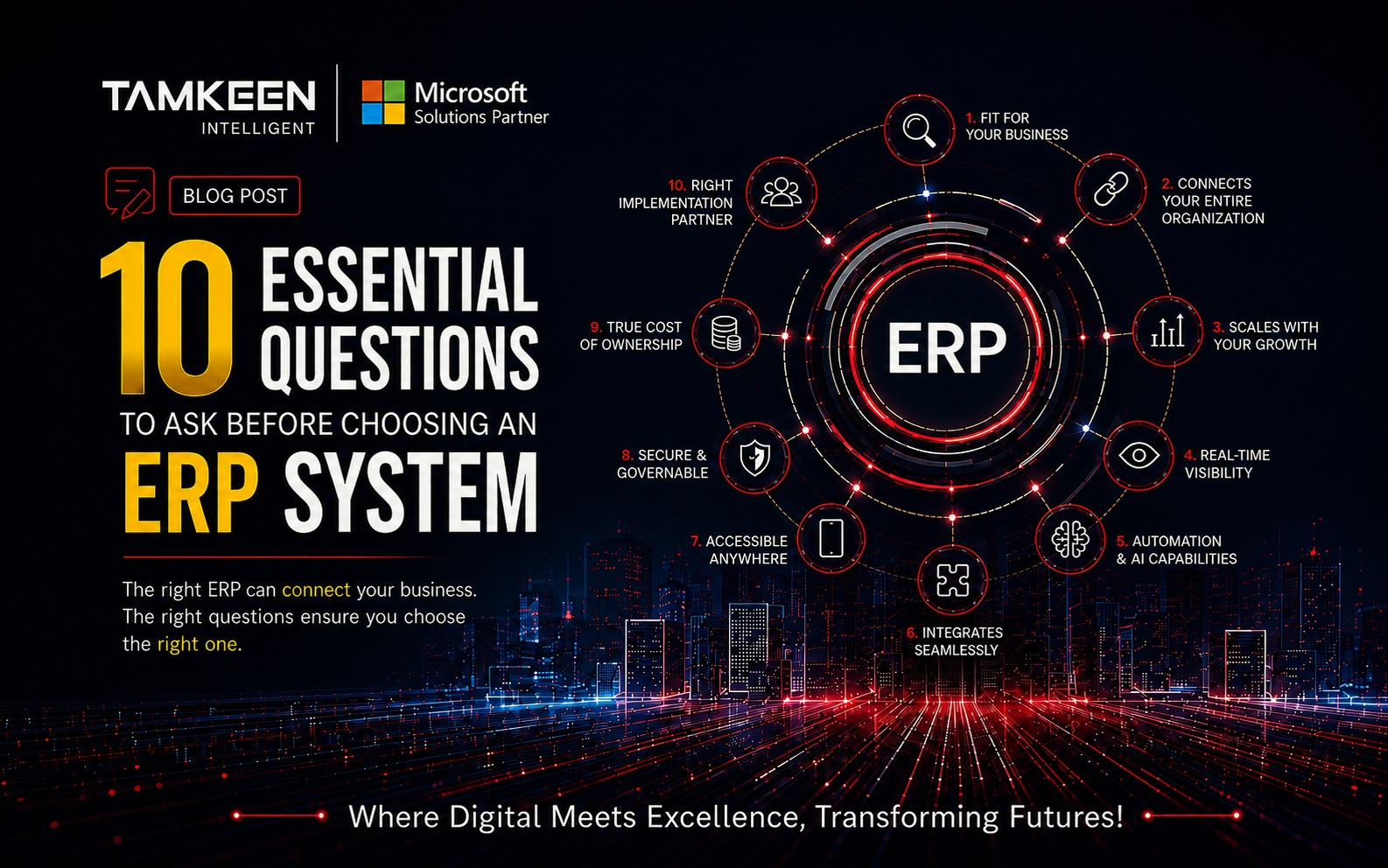
10 Essential Questions to Ask Before Choosing an ERP SystemChoosing an Enterprise Resource Planning (ERP) system is one of the most important technology decisions an organization can make.The right ERP can connect departments, automate processes, improve visibility, strengthen financial control, and create a foundation for long-term growth. The wrong choice can lead to unnecessary complexity, low adoption, costly customization, and a system that struggles to keep pace with the business.And that is why the first question should not be:“Which ERP should we buy?”It should be:“What does our business actually need from an ERP?”Before selecting your next ERP platform, here are 10 essential questions every organization should ask.1. Does the ERP Fit Our Business Processes?Every organization operates differently.A manufacturer may need production planning, inventory management, procurement, quality management, and asset management. A construction company may prioritize projects, budgets, procurement, and financial control. Retailers, real estate companies, healthcare organizations, and logistics businesses each have different operational requirements.Your ERP should support the way your business operates—not force your business into unnecessary complexity.Before selecting a system, identify your critical processes and determine how effectively the ERP can support them.Ask: Can this ERP support our current operations while also adapting to how our business will evolve?2. Can It Connect Our Entire Organization?One of the biggest reasons organizations invest in ERP is to eliminate disconnected systems and data silos.Finance may have one system. Procurement another. Sales may depend on spreadsheets. Inventory information may exist somewhere else entirely.A modern ERP should create a connected environment where departments can work from consistent information.Microsoft Dynamics 365, for example, provides enterprise applications across areas including finance, supply chain, commerce, projects, sales, customer service, and other business functions.The objective should be simple:One connected business instead of multiple disconnected systems.3. Will It Scale with Our Growth?Do not select an ERP based only on the organization you are today.Consider where the company could be in three, five, or even ten years.Will you add new entities? Enter new markets? Increase transaction volumes? Open additional locations? Expand your workforce? Introduce new business models?Replacing an ERP is a major undertaking, so scalability should be considered from the beginning.Choose a platform that can grow with the organization—not one the organization will quickly outgrow.4. Does It Provide Real-Time Business Visibility?An ERP should do more than record transactions.It should help management understand what is happening across the organization.Decision-makers should be able to access relevant information across finance, operations, procurement, inventory, projects, sales, and other critical functions without waiting for teams to manually consolidate multiple reports.With connected ERP data, analytics, and reporting capabilities, organizations can move from asking:“What happened last month?”toward:“What is happening in the business right now?”Better visibility enables faster, more informed decisions.5. How Strong Are Its Automation and AI Capabilities?The ERP conversation is changing.Organizations are no longer looking only for systems that digitize transactions. They increasingly want platforms that can automate work, surface insights, support users, and improve decision-making.When evaluating an ERP, consider its ability to support:Workflow automationApproval processesReporting and analyticsAI-assisted experiencesForecastingException managementProcess automationMicrosoft continues to integrate Copilot and AI capabilities across the Dynamics 365 ecosystem, making AI an increasingly important consideration when evaluating the long-term potential of an ERP platform.The question is no longer only:“What can the system automate?”It is also:“How can the system help our people make better decisions?”6. Can It Integrate with Our Existing Technology?Your ERP will not operate alone.Organizations may already depend on productivity platforms, CRM solutions, banking systems, industry applications, analytics tools, e-commerce platforms, mobile applications, and other technologies.Integration should therefore be a major part of the ERP selection process.For organizations already operating within the Microsoft ecosystem, Dynamics 365 can form part of a broader technology environment alongside solutions such as Microsoft 365, Power Platform, Power BI, Azure, and Copilot.A connected technology ecosystem can reduce fragmentation and make information more accessible across the organization.7. Is the System Accessible to Employees Wherever Business Happens?Enterprise operations no longer happen exclusively behind a desk.Sales representatives meet customers. Project managers work from sites. Logistics teams operate in the field. Executives travel. Managers may need to approve critical requests while away from the office.Organizations should therefore consider how employees will interact with their ERP beyond traditional desktop environments.At Tamkeen Intelligent, this is one of the areas we address through our Intelligent Ecosystem, which extends connected business processes through solutions such as:IOM – Intelligent Operations Management, ISM – Intelligent Sales Management, IIM – Intelligent Inventory Management, ITM – Intelligent Time Management, IPM – Intelligent Property Management, ICM – Intelligent Collection Management, ILM – Intelligent Logistics Management, and IDM – Intelligent Delivery Management.For example, IOM – Intelligent Operations Management helps bring essential processes across Projects, Purchasing, Finance, Sales, Workflows, and Payment Requests closer to users while remaining connected with Microsoft Dynamics 365 Finance & Operations.ERP should not simply connect systems.It should connect people to the business.8. How Secure and Governable Is the Platform?As more critical business processes become digital, ERP security becomes increasingly important.Financial information, supplier records, employee information, operational data, approvals, and business transactions can all flow through the platform.Organizations should evaluate areas such as:User access and permissionsData protectionAuditabilityGovernanceBusiness continuityCompliance requirementsSecurity architectureSecurity should never be treated as something added after implementation.It should be part of the ERP strategy from day one.9. What Is the True Cost of the ERP?ERP cost is much more than the initial software price.Organizations should evaluate the total cost of ownership across the expected life of the solution.This can include software licensing, implementation, integrations, customization, data migration, training, support, upgrades, and ongoing optimization.A cheaper system at the beginning is not necessarily the more economical system over five years.Instead of asking:“How much does the ERP cost?”Ask:“What business value will this investment create?”The goal should be to select an ERP that creates measurable operational and financial value over the long term.10. Are We Choosing the Right Implementation Partner?Even the strongest ERP platform can underperform when implemented without the right strategy.ERP transformation involves much more than technical configuration.Your implementation partner should understand your:Business. Processes. Industry. People. Challenges. Growth strategy.A strong ERP partner should be able to challenge inefficient processes, recommend better approaches, manage change, support adoption, and continue helping the organization after go-live.The technology matters.But the partner behind the transformation matters just as much.ERP Selection Is a Business Decision, Not Just an IT DecisionThe best ERP is not necessarily the system with the longest feature list.It is the platform that can connect your business, support your people, provide visibility, scale with growth, integrate with your technology ecosystem, and continuously evolve.That is why ERP selection should involve stakeholders across finance, operations, supply chain, sales, IT, and executive management.The objective should not simply be to implement new software.It should be to create a stronger operating model for the business.Why Microsoft Dynamics 365?Microsoft Dynamics 365 provides organizations with a connected portfolio of enterprise applications designed to support critical business functions while integrating with Microsoft's wider cloud, productivity, analytics, automation, and AI ecosystem.For organizations considering their next ERP, this creates an opportunity to think beyond traditional enterprise software toward a more connected and intelligent digital environment.Choose the Right ERP. Build the Right Future.At Tamkeen Intelligent, we believe ERP transformation should begin with understanding the business—not installing software.Our teams combine business consulting, Microsoft Dynamics 365 expertise, industry knowledge, implementation capabilities, and intelligent digital solutions to help organizations build connected operations designed around their requirements.Whether your organization is replacing a legacy ERP, consolidating disconnected systems, expanding into new markets, or beginning a wider digital transformation journey, asking the right questions today can prevent costly decisions tomorrow.Before choosing your next ERP, start with the right questions.Tamkeen Intelligent — Where Digital Meets Excellence, Transforming Futures.